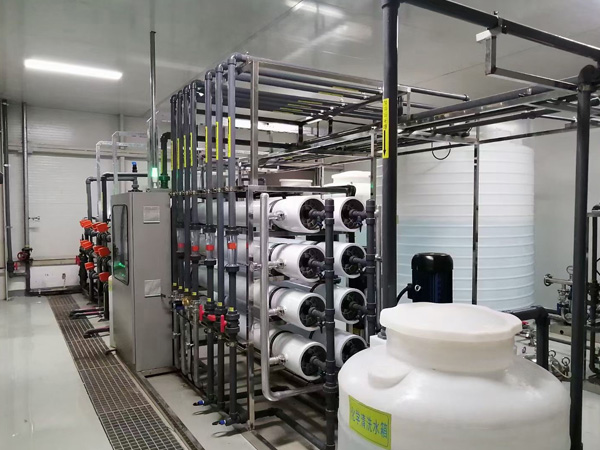
When selecting materials for reverse osmosis equipment, both internal and external factors need to be considered. Internally, it refers to the corrosion of pipelines caused by water quality; externally, it refers to the operating environment. The operating environment of the reverse osmosis equipment determines the external corrosion condition of the pipelines. If the operating environment is relatively good, surface coatings (such as painting or galvanization) are generally sufficient. The corrosion of pipelines caused by water quality must take into account residual chlorine, chemicals, pH value, temperature, etc. Commonly used materials include UPVC and stainless steel.
The basic advantage of stainless steel is its good resistance to general corrosion. Stainless steel rarely experiences electrical corrosion and stress corrosion failure, but it is prone to pitting and crevice corrosion. Pitting refers to localized corrosion of the metal, creating depressions or holes on its surface. If the chromium oxide passive layer is damaged, chloride ions will attack the exposed metal, forming pits. Crevice corrosion is associated with small amounts of stagnant water in tiny holes, around gasket surfaces, deposits, or under screws. To prevent pitting and crevice corrosion in membrane system high-pressure pipelines, the following recommendations are suggested:
For general water sources, 304 stainless steel can be used;
When the raw water salinity is 2-5000 PPM, it is recommended to use 316 stainless steel with a carbon content of less than 0.08%;
When the raw water salinity is 5-7000 PPM, it is recommended to use 316L stainless steel with a carbon content of less than 0.03%;
When the raw water salinity is 7-30000 PPM, it is recommended to use 904L stainless steel with a molybdenum content of 4%-5%.